Nursing School Tips: What I Wish I Knew
Are you considering going to nursing school and wondering what studying may actually entail?
Maybe you are about to enter your first semester of nursing school and want a rundown of what to expect. Wherever you find yourself in your nursing journey, my hope is that these nursing school tips give you the confidence you need to tackle what is before you.
Before going to nursing school, I had no idea what to expect, how to study, or how to steward my time well. Learning how to do these things helped me graduate nursing school with A’s and pass the NCLEX on my first try (thank you, Jesus!).
Nursing school was not easy, but it was truly enjoyable knowing that the information I was spending so much time learning would eventually be used to care for others. I am forever thankful for my experience in nursing school, the skills I learned, and the countless meaningful experiences along the way.
So, if you are preparing for nursing school, I hope these tips help you feel a little more prepared for the journey ahead. Consider this a complete guide to passing nursing school. May God bless you as you embark on a journey of your own!
What to Know Before Nursing School
The goal before nursing school is not to know it all but to simply lay a foundation of the human body and some basic terms. A lot of these very basic things can be learned in high school or simply by watching YouTube videos. Memorizing this is not the goal, but being familiar with them by the time you get to class is.
Learn Basic Health Science Terms
Some resources that may help:
Review Basic Anatomy and Physiology
You do not need to know every detail of anatomy and physiology before nursing school. However, having a basic overview of the major body systems can make the information you learn later much easier to understand.
A few resources I enjoyed:
- Human Body Systems Overview (animation)
- 11 Organ Systems of the Human Body (love this one)
Don’t Try to Know It All
You don’t have to know it all before school starts. Your professors will teach you the details you need to know. For now, simply having a basic understanding of anatomy, physiology, and medical terminology can go a long way.
How to Study in Nursing School
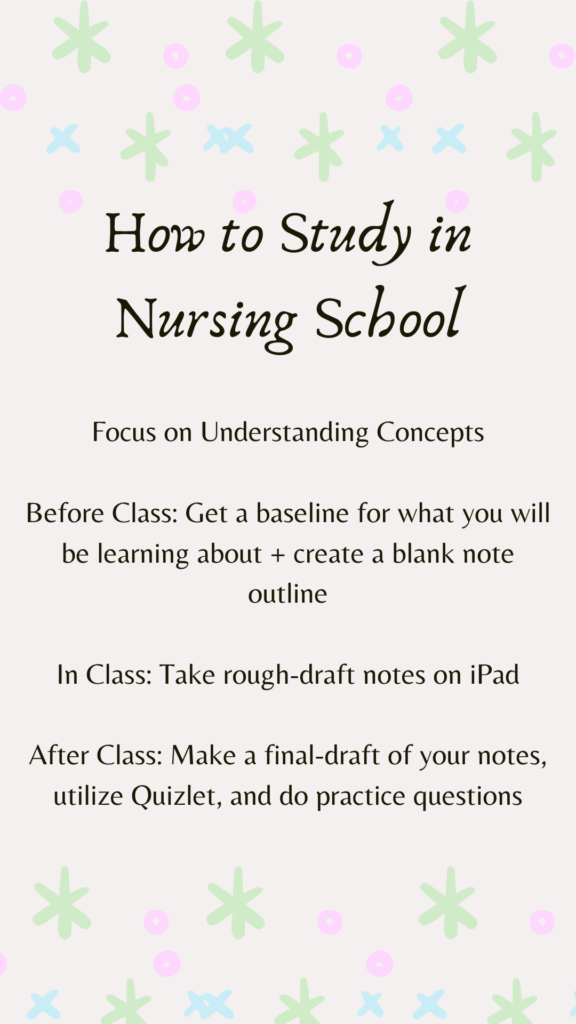
Focus on Understanding Concepts
One of the biggest lessons I learned in nursing school was that understanding the concept is much more valuable than simply memorizing information.
Here is the process that worked well for me.
Before Class
Get a baseline for what you will be learning about. Your instructors will likely give you a heads up on topics or chapters.
- Some ways that I found the most helpful were
- Watching videos
- Skim the chapter(s) by reading topics, vocabulary, and headings
- Download the presentation the instructor will use in class if possible
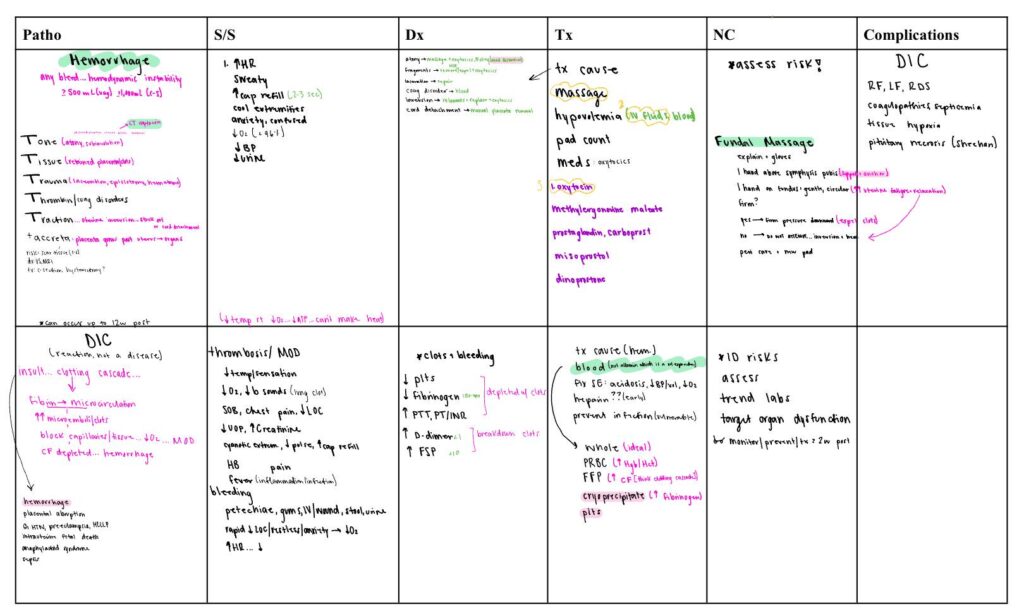
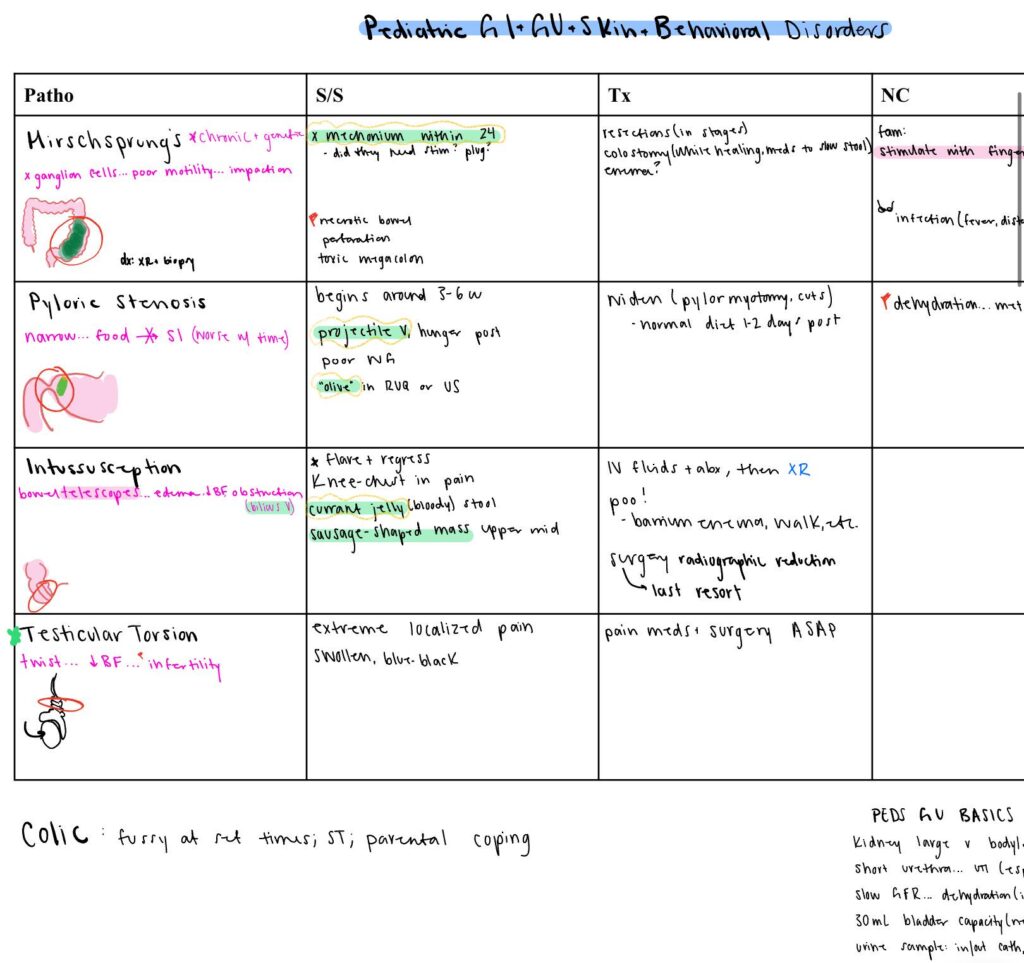
- Create an outline or basic notes sheet before class (then, you can easily fill them in after class, and get a mental picture for how to organize your information)
- I usually created a chart like this one on Google Docs with the amount of columns needed, sent it to notability on my iPad, and wrote on that
During Class
I used my iPad to take notes directly on the presentation my instructor provided.
We used PowerPoint, so I would download the presentation into Notability and write directly on the slides.
I tried not to write down everything the instructor said. Instead, I focused on information that was not already included in the presentation.
If an instructor said, “You have to know this,” or repeatedly emphasized a particular concept, I made sure to write it down. I marked these especially important sections in green.
This helped me avoid spending class time writing down information that was already in front of me and allowed me to focus on what my instructor was emphasizing.
How to Color Code Your Notes
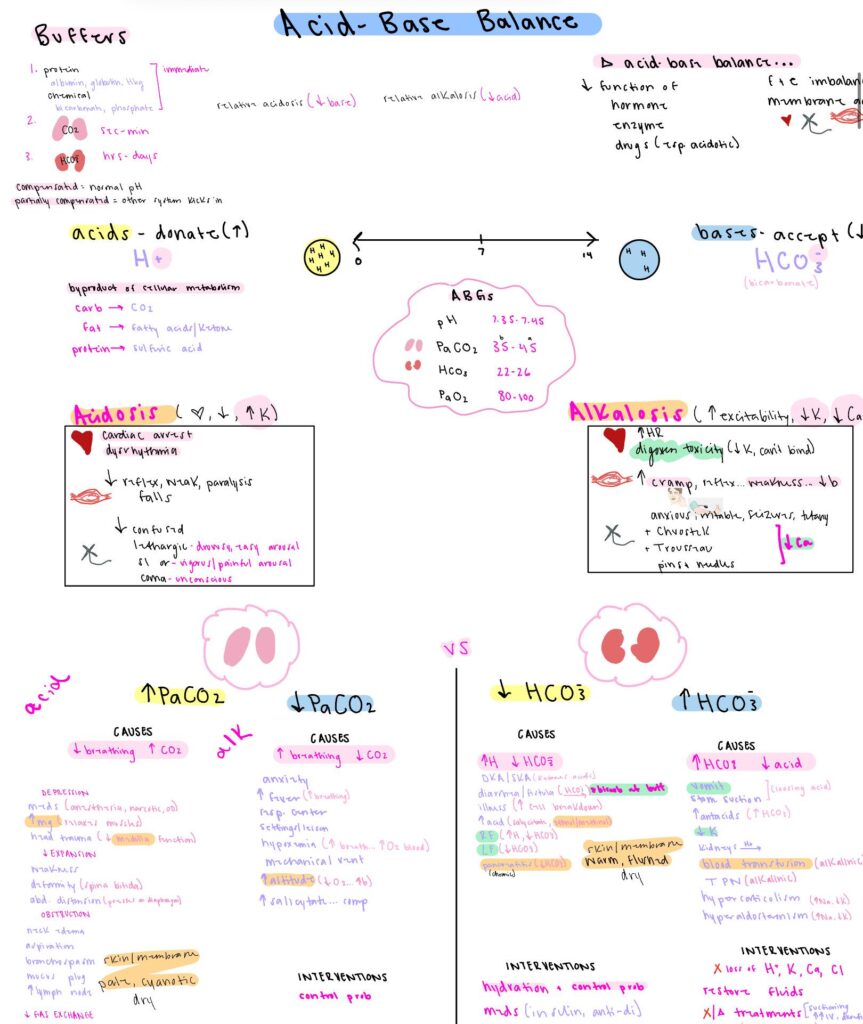
I used a pretty basic system of either pen color or highlighting that worked like this:
I used a simple color-coding system for my notes and highlighting:
- Green: Must know
- Pink: Important
- Orange: I don’t understand this yet — keep reviewing or ask questions
- Yellow: New vocabulary
- Purple: Examples
The specific colors don’t matter nearly as much as being consistent.
Having a system helped me quickly identify what I needed to review when I went back through my notes.
What To Do After Class
Make Notes
- I recommend using an iPad for note-taking and studying. I found this to be very helpful.
- Split the screen on the iPad with the presentation on one side and your notes template on the other
- Fill in your notes from the presentation and organize them in a way that makes sense for you
- At the end, you will have a made a completed study guide
A Few Note-Taking Tips
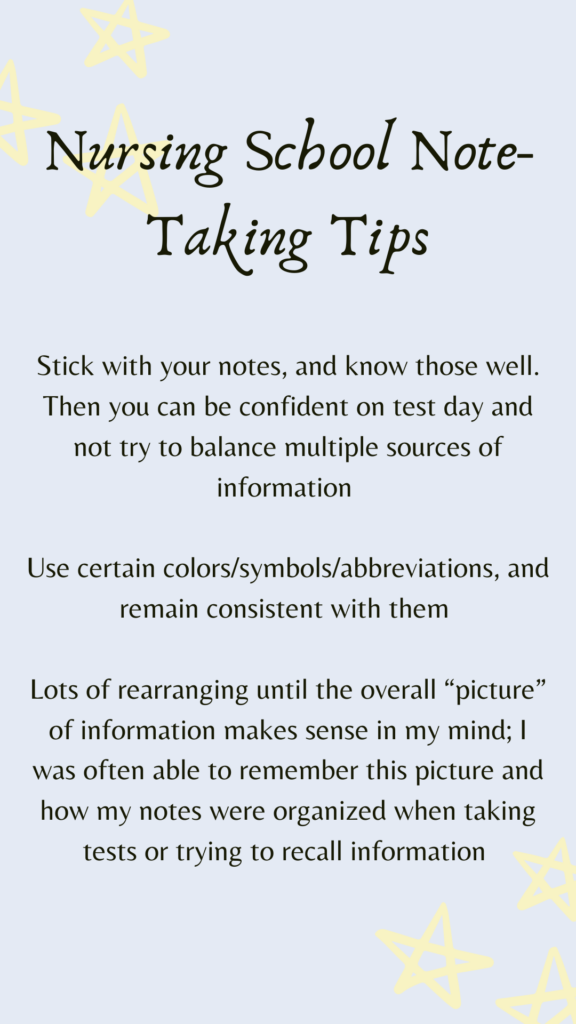
Stick with your notes, and know those well. Then you can be confident on test day and not try to balance multiple sources of information
Use certain colors/symbols/abbreviations, and remain consistent with them
Lots of rearranging until the overall “picture” of information makes sense in my mind; I was often able to remember this picture and how my notes were organized when taking tests or trying to recall information
Study Your Notes
Read Over Your Notes
Read through your completed notes and make sure you understand what you are looking at.
Make Quizlets
I loved using Quizlet to study vocabulary words, disease processes, pathophysiology, treatments, and other information that needed repetition.
Teach It Out Loud
Pretend you are teaching someone else.
Explain the concept out loud without looking at your notes. If you can’t explain it, that is a good indication that you need to review it again.
Write It Out
Take a blank version of your notes chart and try to fill it in from memory.
This was especially helpful because it showed me the gaps in my knowledge and helped me identify exactly what I needed to study.
Repeat Your Reviews
One study method that worked well for me was reviewing the material multiple times throughout the day and over several days.
For example, I would review something three times throughout the day for at least three days. After that, I would simply refresh the material periodically because it was already becoming familiar.
Sometimes this meant going through my Quizlet flashcards several times. I especially liked Quizlet because I could separate the terms I did not know from the ones I had already mastered and focus my attention where it was needed.
The exact number of reviews will look different for everyone. The important thing is repeatedly recalling the information instead of simply reading it once.
Test Your Knowledge With Practice Questions
Practice questions were a huge part of my nursing school preparation.
Once I understood the material, I would do a large number of practice questions. At times, I did around 100 questions in a day, but the important thing is not necessarily the number. The goal is to practice applying what you know.
I would sit down and treat the practice questions like an actual exam.
The more comfortable I became with answering questions, the less intimidating exam day felt.
Where to get practice questions?
- Quizlet (e.g., search “peds respiratory NCLEX questions Quizlet”)
- RegisteredNurseRN
- Kaplan (my school included this with our tuition)
- Nexus Nursing
- Question bank from your book if it has one (used this when first studying the info since it is more fact and less critical thinking)
Ask Questions
I had a whole separate notes sheet just for questions. I would either email the questions or meet with my instructor after class or on an assigned time. Meeting in person is definitely best, because it allows you to critically think and build a relationship with your instructor. This really boosts your confidence on test day!
What to Memorize and Review
Lab values are very important and are something you will want to memorize when your instructors ask you to. The trick is to memorize them, and continue to review them, since you will see them all throughout nursing school and on the NCLEX.
Make a single chart/note sheet of labs to keep adding to and reviewing throughout school. Do not worry about memorizing the difference between male and female values.
Here is an example, but I would encourage you to make your own with the values your instructors use. This is the Quizlet I made and used.
A Nursing-Approved “Cheat Sheet”
If there are some terms or things you want to remember, practice writing them down so you can have a little “cheat sheet” that you can re-write on test day. Lab values are something I liked to add.
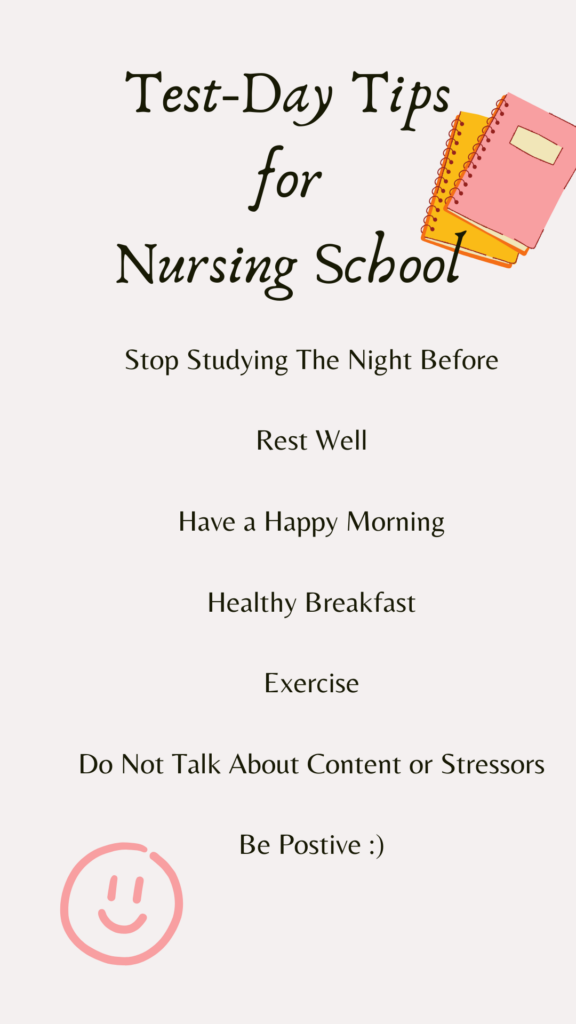
Test Day Tips
Stop Studying The Night Before
I made a rule to stop studying after dinner, relax, and get some sleep! Many studies show that this leads to better outcomes.
Have a Happy Morning
In the morning, have a healthy breakfast, get some exercise in, and keep the stress to a minimum. A lot of your classmates will be stressed the morning of, cramming in studying, and causing a lot of unnecessary anxiety. Keep to yourself, go for a walk, and talk to the Lord.
A Perfectly Acceptable “Cheat Sheet”
When you get to the test, write down your little “cheat sheet” if needed. Make sure your instructor allows this. Ours would give us a blank peice of paper and let us write whatever we wished!
Process of Elimination
When reading a question, immediately eliminate the answers you know are wrong. Once you know the information and learn how to take nursing school tests, you will learn how to “play the game.”
Ask Questions
If the wording of a question is not clear, ask for clarification.
Review Missed Questions
After the test, ask the instructor if you can review the answers you got wrong. They love the effort, and you will be blessed by seeing your blind spots.
Final Nursing School Tips and Encouragemnet
Nursing school is a lot of work, but it is also an incredible opportunity to learn how to care for people well.
You do not have to know everything before you begin.
You do not have to study exactly like everyone else.
And you certainly do not have to have it all figured out on day one.
Find a study system that works for you, learn to understand concepts rather than simply memorize them, ask questions when you are confused, and give yourself plenty of time to practice.
Most importantly, don’t forget why you are doing this.
There will be long days, difficult exams, and moments when you wonder if you can do it. But there will also be moments that remind you why you started.
I hope these nursing school tips helped you feel a little more prepared for the journey ahead. If you have any questions or nursing school tips of your own, leave them in the comments!
We need more awesome nurses out there!